
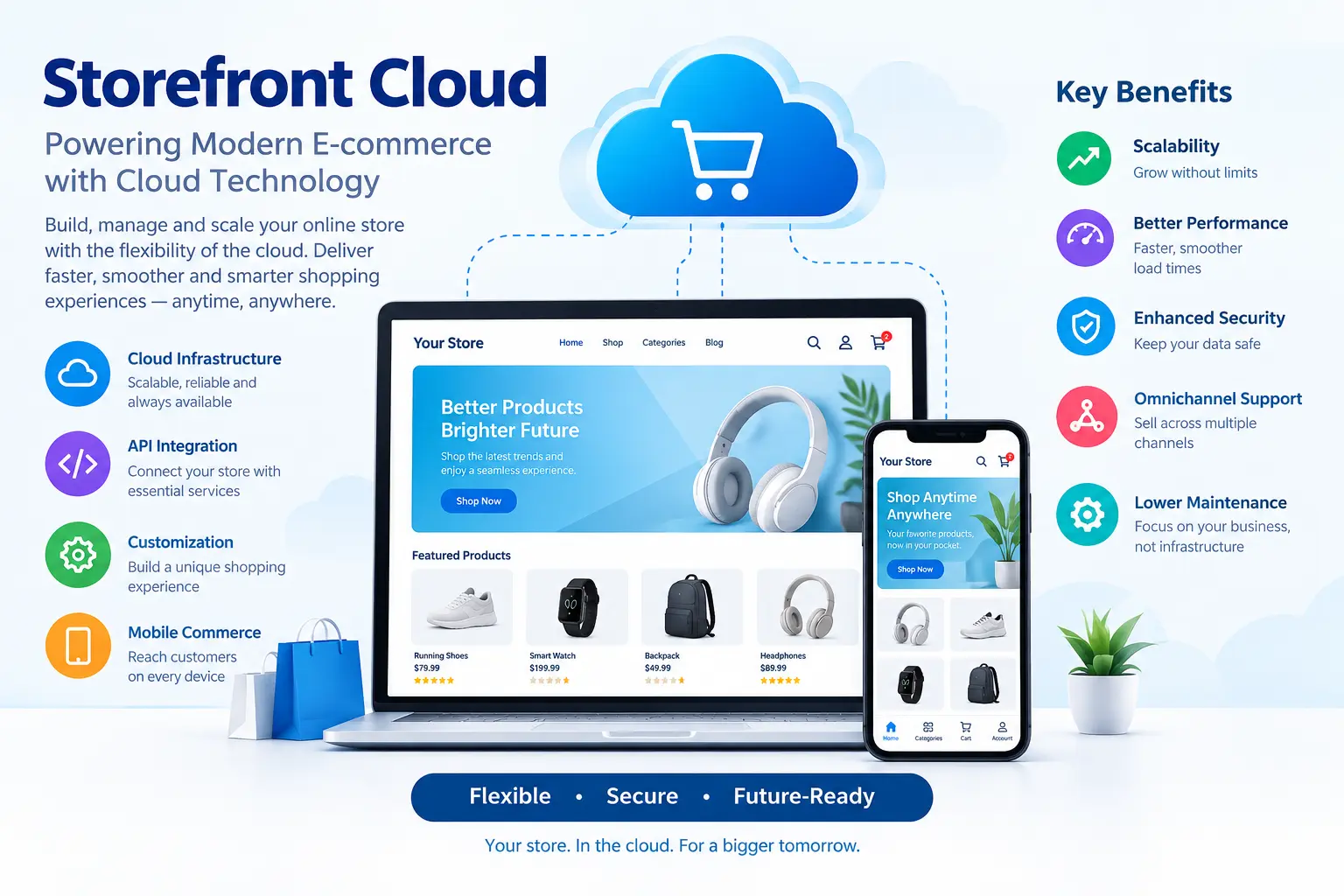
Online shopping has changed the way businesses attract customers, present products, and generate sales. Customers now expect fast-loading websites, convenient payment options, personalized recommendations, and smooth shopping experiences across different devices. To meet these expectations, companies increasingly explore cloud-based storefront technology as part of their digital commerce strategy.
Storefront Cloud is a useful term for understanding how cloud technology can support modern online shopping environments. A cloud-based storefront can help businesses manage digital experiences, connect commerce services, and adapt their websites as customer needs evolve. Depending on the platform, these environments may also support headless commerce, API integrations, inventory synchronization, and omnichannel selling.
This guide explores Storefront Cloud technology, its potential features, practical benefits, common applications, and important considerations for businesses evaluating modern e-commerce solutions.
What Is Storefront Cloud?
Storefront Cloud refers to a cloud-based approach to delivering and managing an online storefront. Instead of relying entirely on a traditional, tightly integrated website system, businesses may use cloud infrastructure and connected services to build flexible digital shopping experiences.
A storefront is the customer-facing part of an online business. It includes product pages, navigation menus, search tools, shopping carts, checkout interfaces, and other elements that help visitors discover and purchase products. Cloud technology can provide the infrastructure needed to deliver these experiences efficiently.
Depending on the implementation, a cloud-based storefront may connect with separate systems for product information, payment processing, order management, customer accounts, and inventory tracking. This arrangement allows businesses to choose services that suit their operational requirements.
It is important to distinguish the general concept from a specific commercial product. The exact capabilities, pricing, integrations, and security features depend on the provider. Therefore, businesses should verify product-specific claims before selecting a particular Storefront Cloud platform.
How Does Storefront Cloud Work?
A cloud storefront combines several technical components to deliver a functioning online shopping experience. These components communicate through connected services, allowing customers to browse products while business systems manage the information and transactions behind the scenes.
Although individual architectures differ, the following components commonly appear in modern cloud commerce environments.
1. Cloud Infrastructure
Cloud infrastructure provides computing resources, storage, networking, and other services required to operate a digital storefront. Businesses can use managed infrastructure rather than maintaining every server and supporting system themselves.
Depending on the provider, resources may scale as traffic changes. This flexibility can be particularly useful during seasonal promotions, product launches, and other periods when visitor numbers increase unexpectedly.
2. Storefront Interface
The storefront interface is the visual layer customers interact with. It includes product images, descriptions, category pages, search results, navigation, and checkout screens.
Developers can customize this layer to reflect a company’s branding and customer experience goals. Some platforms provide ready-made templates, while others support more advanced development using modern frontend frameworks.
3. APIs and Connected Services
Application programming interfaces, commonly called APIs, allow different software systems to exchange information. A storefront may use APIs to retrieve product details, check stock availability, calculate shipping costs, or submit orders.
For example, when a customer selects a product, the storefront can request current pricing and availability from the appropriate commerce service. This helps coordinate the customer-facing experience with the business systems responsible for processing orders.
4. Commerce Management Systems
A storefront often depends on additional tools for product catalogs, customer records, payment processing, fulfillment, and order management. These services can operate together through integrations rather than being confined to one application.
The exact setup depends on business size, technical resources, and operational complexity. A smaller retailer may need only a few integrations, while a larger company could require multiple systems across different regions.
Key Storefront Cloud Features
The features available in a cloud-based storefront depend on the platform and its configuration. Nevertheless, several capabilities are especially relevant when evaluating modern e-commerce technology.
Flexible Storefront Customization
Customization allows businesses to create an online store that reflects their identity and serves their customers effectively. Companies can adjust layouts, typography, navigation, product presentation, and promotional sections according to their brand guidelines.
A flexible storefront can also support different shopping experiences for different audiences. For instance, a fashion retailer may prioritize product photography and style filters, whereas a business-to-business supplier may emphasize technical specifications, bulk ordering, and account-based pricing.
Product Catalog Management
Product catalog management involves organizing product names, descriptions, images, prices, categories, and attributes. A well-structured catalog makes it easier for shoppers to find relevant items and compare available options.
When connected to appropriate management systems, a storefront can display updated product information without requiring staff to edit every page manually. Businesses with extensive catalogs should evaluate whether their chosen solution supports bulk updates, variant management, and reliable data synchronization.
Payment Integration
Convenient checkout is essential for completing online purchases. A storefront may integrate with payment gateways that support suitable payment methods, transaction processing, and order confirmation.
Businesses should examine the available payment providers, supported currencies, regional restrictions, and transaction costs before committing to a solution. Payment security also requires appropriate configuration, secure connections, and compliance with applicable payment industry requirements.
Mobile Commerce Support
Many customers browse and purchase products through smartphones. A mobile-friendly storefront adjusts its layout to smaller screens and makes essential actions easy to complete.
Clear navigation, readable product information, appropriately sized buttons, and a straightforward checkout process can reduce unnecessary friction. Mobile performance should be tested on real devices rather than judged solely from a desktop preview.
Analytics and Performance Monitoring
Analytics tools can help businesses understand visitor behavior, popular products, checkout abandonment, and conversion patterns. These insights provide a foundation for improving product pages and customer journeys.
Performance monitoring can also reveal slow-loading resources, technical errors, and traffic-related issues. Available analytics and monitoring capabilities vary by platform, so organizations may need to integrate external tools.
Benefits of Storefront Cloud for E-commerce Businesses
A cloud-based storefront can offer several advantages when its capabilities align with a company’s goals. However, the results depend on implementation quality, hosting arrangements, integrations, and ongoing management.
Improved Scalability
Online businesses rarely experience perfectly consistent traffic. Advertising campaigns, seasonal shopping, and viral product interest can create sudden increases in demand.
Cloud-based infrastructure may allow businesses to adjust computing resources according to workload. This can reduce the need to purchase and maintain enough physical infrastructure for occasional traffic peaks, although scaling limits and additional usage charges still require attention.
Better Website Performance
Website speed influences how customers interact with product pages and checkout screens. Delays can interrupt browsing and make purchases more frustrating, especially on slower mobile connections.
A well-configured cloud storefront may use content delivery networks, caching, optimized assets, and efficient application architecture to improve responsiveness. Cloud hosting alone does not guarantee a fast website; developers must also optimize images, scripts, databases, and third-party integrations.
Greater Development Flexibility
Traditional e-commerce systems sometimes connect the storefront and business logic so closely that changing one component affects several others. More modular architectures can give development teams greater freedom to update the customer-facing experience independently.
This flexibility may help businesses introduce new features, experiment with different layouts, or integrate specialized services. Nevertheless, modular systems also require careful coordination to prevent integration problems and unnecessary technical complexity.
Support for Omnichannel Commerce
Customers may discover products through a website, social media, mobile applications, or physical stores. Omnichannel commerce aims to provide a consistent experience across these touchpoints.
A suitable storefront architecture can connect with inventory, customer, and order management systems to support coordinated operations. Actual capabilities depend on the integrations available and how reliably information is synchronized between channels.
Reduced Infrastructure Management
Managed cloud services can reduce the amount of server maintenance handled directly by a business. Providers may manage infrastructure updates, monitoring, backups, and other operational tasks according to the selected service plan.
However, responsibilities are not automatically eliminated. Businesses must understand which tasks remain their responsibility, including application maintenance, access controls, data protection, and recovery planning.
Storefront Cloud and Headless Commerce
Headless commerce is an architectural approach in which the customer-facing storefront operates separately from the commerce backend. The two layers communicate through APIs or other supported interfaces.
This separation allows businesses to change the presentation layer without necessarily rebuilding the entire commerce system. For example, a retailer might redesign its website while continuing to use its existing product, pricing, and order management services.
A Storefront Cloud implementation may support headless commerce, but the two terms are not interchangeable. Cloud technology describes where or how services are delivered, while headless commerce describes how the storefront and backend are separated.
Headless architecture can be valuable for businesses that need extensive customization, multiple customer-facing channels, or independent development workflows. Smaller businesses with straightforward requirements may find a conventional, integrated platform easier and less expensive to manage.
The right choice depends on the company’s budget, technical expertise, growth plans, and need for customization.
Storefront Cloud vs. Traditional E-commerce Platforms
Both cloud-based storefronts and traditional e-commerce platforms can support online sales. The main differences usually involve flexibility, infrastructure management, integration requirements, and the level of technical control available.
Traditional platforms may provide a unified package containing themes, catalog management, checkout, and administrative tools. This arrangement can simplify setup because many components already work together.
A cloud-based or modular storefront may offer more flexibility in how services are selected and connected. It can be useful when a business needs specialized functionality or wants to develop separate experiences for different sales channels.
However, greater flexibility can introduce additional costs. Businesses may need developers to configure APIs, monitor integrations, and resolve issues between independently managed systems.
Before making a decision, compare the following factors:
- Setup: How much work is required to launch the storefront?
- Customization: Can the design and functionality meet your needs?
- Maintenance: Who manages updates, hosting, and technical support?
- Integrations: Are essential payment, inventory, and shipping services supported?
- Scalability: Can the solution accommodate expected growth?
- Total cost: What will hosting, subscriptions, development, and maintenance cost over time?
A traditional platform may be appropriate for a small store seeking simplicity. A modular cloud architecture may be more suitable for a business with complex integrations or ambitious digital expansion plans.
Storefront Cloud Security Considerations
Security should be a priority when choosing any online commerce infrastructure. Storefronts handle customer interactions and may connect to systems containing personal information, transaction records, and business data.
A responsible implementation begins with encrypted connections, strong authentication, carefully assigned user permissions, and timely software updates. Businesses should also evaluate how the platform handles security monitoring, incident response, and vulnerability management.
Payment processing requires particular attention. Organizations should use reputable payment providers and understand their responsibilities under applicable payment security standards. Sensitive payment information should not be stored unnecessarily.
Regular backups and tested recovery procedures can help businesses restore operations after accidental data loss or technical failures. Access logs and monitoring can also help identify suspicious activity.
Finally, companies should review the provider’s privacy policies, data storage locations, contractual terms, and compliance documentation. Security capabilities should be verified through official documentation rather than assumed from the word “cloud.”
Storefront Cloud Pricing: What Should Businesses Expect?
There is no universal price for Storefront Cloud as a general technology category. Costs depend on the selected provider, service plan, infrastructure requirements, and complexity of the storefront.
A basic hosted storefront may involve a monthly subscription, while a customized architecture can require separate spending on development, hosting, APIs, and ongoing technical support.
Businesses should account for more than the initial setup cost. Payment processing fees, premium integrations, analytics services, maintenance contracts, and additional infrastructure usage can increase the overall expense.
A practical budget should include:
- Platform subscriptions and hosting.
- Website design and development.
- Third-party applications and API integrations.
- Payment processing and transaction charges.
- Security, backups, and monitoring.
- Maintenance, support, and future improvements.
When comparing providers, estimate the total cost of ownership over at least one to three years. This approach provides a more realistic picture than comparing advertised monthly prices alone.
Is Storefront Cloud Suitable for Small Businesses?
Storefront Cloud technology can be suitable for small businesses, but the best implementation depends on their requirements and available resources.
A new retailer selling a limited range of products may benefit more from an integrated platform with built-in templates, payment processing, and simple inventory tools. Such a solution can reduce setup time and avoid unnecessary development work.
A growing business with several sales channels, a large catalog, or specialized customer requirements may benefit from a more flexible architecture. In that situation, cloud services and modular integrations can support expansion without forcing every component to be replaced at once.
Small businesses should consider their technical skills, monthly budget, expected order volume, and plans for future growth. Starting with a manageable solution and expanding when necessary can be more practical than adopting a complex architecture immediately.
How to Choose the Right Storefront Cloud Solution
Selecting an appropriate platform requires a clear understanding of current needs and long-term objectives. Businesses should evaluate real capabilities rather than relying only on marketing descriptions.
Start by identifying essential requirements. These might include mobile-friendly design, regional payment methods, product variants, inventory synchronization, shipping integrations, or support for multiple languages.
Next, examine the platform’s technical documentation. Check API availability, integration limits, performance expectations, security controls, and data export options. These details help determine whether the solution can support everyday operations.
It is also wise to test the checkout process and administrative interface before committing. A trial or demonstration can reveal usability problems that are difficult to identify from feature lists alone.
Finally, investigate support quality and vendor reliability. Understand the service-level commitments, maintenance arrangements, pricing changes, and procedures for leaving the platform if your requirements change.
The strongest choice is not necessarily the platform with the largest feature list. It is the solution that reliably supports your customers and business processes without creating unnecessary operational complexity.
The Future of Cloud-Based Storefront Technology
Digital commerce continues to evolve as customers expect faster interactions, more relevant product recommendations, and consistent experiences across devices. Cloud infrastructure and modular software architectures can help businesses respond to these changing expectations.
Artificial intelligence may support product discovery, customer service, search relevance, and personalized recommendations. Automation can also help coordinate inventory updates, order notifications, and routine administrative tasks.
Composable commerce is another important development. It allows businesses to assemble commerce capabilities from separate services rather than depending entirely on a single application. This approach can offer flexibility, although managing multiple vendors requires strong technical planning.
Progress in these areas will not eliminate the need for sound business decisions. Companies will still need accurate product information, reliable fulfillment, transparent pricing, accessible website design, and dependable customer support.
For this reason, the future of Storefront Cloud is best understood as part of a broader movement toward adaptable, connected, and customer-focused digital commerce.
Conclusion
Storefront Cloud represents a useful concept for understanding how cloud technology can support modern online storefronts. Depending on the implementation, it may help businesses improve flexibility, connect commerce services, support multiple sales channels, and respond to changing customer expectations.
Its value depends on choosing the right architecture, evaluating security carefully, monitoring performance, and understanding the complete cost of ownership. Cloud infrastructure by itself does not guarantee better conversions or faster websites; thoughtful implementation and continuous improvement remain essential.
For businesses exploring new e-commerce solutions, the best starting point is to identify their immediate needs, compare suitable platforms, and verify the features each provider actually offers. With a practical strategy, cloud-based storefront technology can become a valuable part of a sustainable digital commerce operation.
Frequently Asked Questions
What is Storefront Cloud used for?
Storefront Cloud is a term associated with cloud-based storefront technology. Depending on the implementation, it can support online product displays, connected commerce services, website customization, and digital shopping experiences.
What are the main benefits of Storefront Cloud?
Potential benefits include flexible infrastructure, easier integration with other services, adaptable storefront design, and support for growing traffic. Actual results depend on the platform and its configuration.
Is Storefront Cloud the same as headless commerce?
No. Cloud storefront technology concerns cloud-based delivery and infrastructure, while headless commerce separates the customer-facing storefront from the commerce backend. A solution can use both approaches.
Does Storefront Cloud support mobile commerce?
A cloud storefront can deliver mobile-friendly shopping experiences when its design and platform support responsive layouts or dedicated mobile interfaces. Mobile usability should be tested on different devices.
How much does Storefront Cloud cost?
Pricing depends on the specific provider, subscription plan, hosting requirements, development needs, and integrations. Businesses should verify official pricing and calculate ongoing costs before choosing a solution.
Is Storefront Cloud secure?
Security depends on the provider and implementation. Businesses should review encryption, access controls, payment security, backups, monitoring, and relevant compliance documentation before deploying a storefront.
Can Storefront Cloud help a growing e-commerce business?
It can, particularly when the chosen solution supports the business’s expected traffic, integrations, and operational requirements. Companies should assess scalability alongside cost, complexity, and technical support.
