
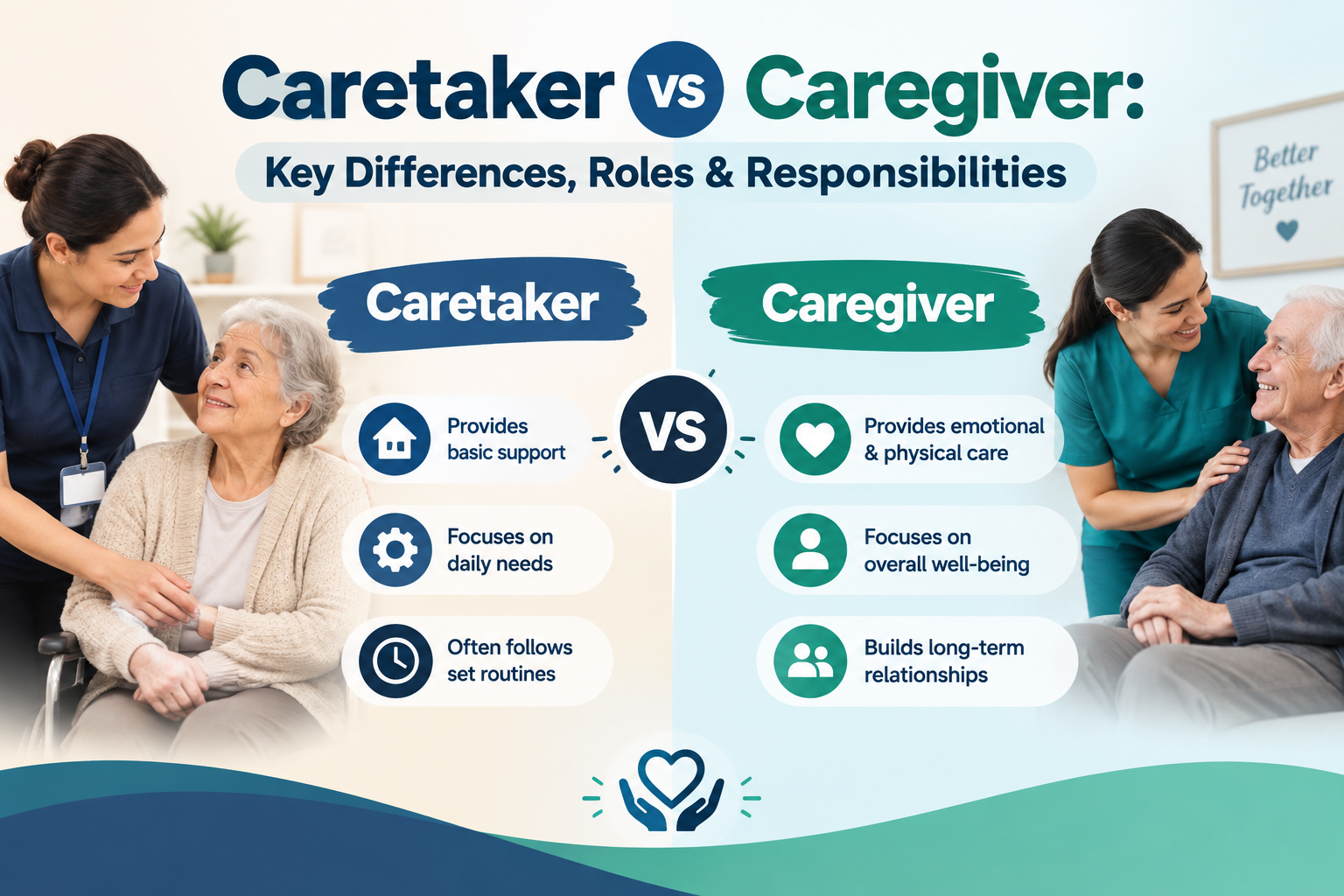
Choosing the right person to look after a family member, property, or someone who needs daily assistance can be confusing. Two terms that often create uncertainty are caretaker and caregiver. Although people sometimes use these words interchangeably, their responsibilities can be quite different.
Understanding caretaker vs caregiver is important when hiring help for an older adult, supporting a person with limited mobility, arranging household assistance, or managing a property. The right choice depends on what needs attention, how much personal support is required, and whether the role involves emotional, physical, or practical care.
A caretaker generally focuses on maintaining, protecting, or looking after a person, place, or property. A caregiver usually provides direct assistance to someone who needs help with everyday activities or personal well-being. However, duties can overlap depending on the employer, workplace, and individual needs.
This guide explains the meaning of each term, their main differences, daily duties, required skills, employment opportunities, and factors to consider before hiring either professional.
What Is a Caretaker?
A caretaker is someone responsible for looking after a person, building, property, facility, or another assigned responsibility. The exact meaning depends on the environment in which the person works.
For example, a caretaker in an apartment building may inspect shared spaces, report maintenance problems, and help keep the property secure. A caretaker working in a private home may assist with household tasks and provide general supervision. In some settings, caretakers also help people who need basic daily support.
The central feature of the role is responsibility for maintaining or overseeing something. Direct personal care may be included, but it is not always the main purpose of the job.
Common caretaker duties
A caretaker’s work may involve:
- Keeping assigned rooms, buildings, or outdoor areas in suitable condition.
- Checking doors, windows, equipment, and other property features.
- Reporting damage or arranging repairs when authorized.
- Monitoring access to a building or facility.
- Completing basic cleaning and organizing tasks.
- Performing routine inspections.
- Providing general assistance according to an agreed job description.
- Informing the owner, supervisor, or family about concerns.
These duties are examples rather than a universal checklist. A school caretaker, residential caretaker, and person employed to assist an older adult may have very different responsibilities.
Where do caretakers work?
Caretakers may be employed in residential buildings, schools, offices, holiday homes, community facilities, farms, and private households. Some positions are live-in arrangements, while others involve scheduled visits or regular shifts.
The job description matters more than the title alone. Before accepting a caretaker position, workers should clarify whether the employer expects property maintenance, household assistance, personal care, or a combination of these services.
What Is a Caregiver?
A caregiver provides support to a person who needs help with daily living, comfort, safety, or personal well-being. The person receiving care may be an older adult, a person with a disability, someone recovering from an illness, or an individual who needs temporary assistance.
Caregivers can be family members, privately hired workers, or professionals employed by home-care agencies and other organizations. Their duties vary according to the person’s needs, the caregiver’s training, and applicable local requirements.
Unlike a role focused mainly on maintaining a property, caregiving typically centers on the individual receiving assistance.
Common caregiver duties
Depending on the care plan and qualifications, a caregiver may:
- Help with dressing, grooming, and other personal routines.
- Prepare meals and encourage appropriate hydration.
- Assist with walking, transfers, or movement when trained to do so.
- Offer companionship and emotional reassurance.
- Help organize appointments and daily activities.
- Remind someone about a medication schedule when permitted by the care plan and local rules.
- Observe changes in mood, mobility, appetite, or general condition.
- Communicate concerns to family members or healthcare professionals.
- Assist with approved exercises or everyday activities.
- Maintain a safe, comfortable environment.
Some caregivers provide only companionship and household assistance. Others work in more demanding settings with formal training and supervision.
Different types of caregivers
Family caregiver: A relative or friend who helps someone without necessarily being employed professionally.
Professional caregiver: A paid worker who provides support through an agency or private arrangement.
Home caregiver: A person who assists clients in their own homes.
Live-in caregiver: A caregiver who resides in the home under an agreed employment or care arrangement.
Specialized caregiver: A worker trained to support particular needs, such as dementia care or disability support. The scope of work depends on qualifications and local regulations.
Caregiving is not automatically the same as nursing. Nurses have specific professional training and regulated responsibilities that ordinary caregivers may not be qualified to perform.
Caretaker vs Caregiver: Main Differences
The most useful way to compare these roles is to examine their primary purpose, daily tasks, and level of direct involvement with the person receiving support.
| Comparison factor | Caretaker | Caregiver |
|---|---|---|
| Main purpose | Overseeing or maintaining a person, place, or property | Supporting an individual’s daily needs and well-being |
| Typical focus | General upkeep, supervision, security, or practical assistance | Personal support, comfort, companionship, and daily living |
| Property maintenance | Often an important duty in property-related roles | Usually secondary to the person’s care |
| Personal assistance | May be included, depending on the job | Commonly part of the role |
| Emotional support | Depends on the setting | Often an important part of the relationship |
| Health-related observation | May be limited to general observations | Often involves noticing and reporting changes in the person’s condition |
| Training | Depends on the position and responsibilities | Depends on care needs and the level of support required |
| Typical workplace | Buildings, residential properties, facilities, or homes | Private homes, care agencies, residential facilities, and community settings |
| Suitable situation | Property oversight or general assistance is the main requirement | A person needs regular support with daily activities |
| Scope of work | Defined by the property, facility, or assigned responsibility | Defined by the individual’s needs and care plan |
These are general distinctions, not strict legal definitions. Employers sometimes use the terms differently, so always review the actual responsibilities rather than relying on the job title.
An easy example
Imagine a family hires two workers to help an older relative remain at home.
One worker checks the house, arranges minor maintenance, keeps the living areas organized, and reports safety problems. That position is closer to a caretaker role.
The second worker helps the older adult get dressed, prepares meals, offers companionship, and assists with everyday routines. That position is closer to a caregiver role.
If one employee performs both sets of duties, the position may combine caretaker and caregiver responsibilities.
Responsibilities of a Caretaker
Caretaker duties are shaped by the property, facility, or person under their supervision. In a residential setting, the job may combine general maintenance with practical household support.
1. Property supervision
Caretakers may inspect the areas they are responsible for and report issues that require attention. For example, they might notice a damaged lock, a leaking tap, or a faulty light and notify the appropriate person.
Their role does not necessarily include performing specialist repairs. Electrical, structural, or other hazardous work should be handled by appropriately qualified professionals.
2. Routine maintenance
Some caretakers complete simple tasks such as replacing approved supplies, checking common areas, or arranging access for maintenance workers.
A clear agreement should specify which tasks are included and which require outside contractors.
3. Safety and security
Depending on the position, a caretaker may check that entrances are secured, monitor unusual activity, and report potential hazards. They may also follow emergency procedures established by the property owner or employer.
Caretakers should not be expected to manage dangerous incidents beyond their training.
4. Household assistance
A caretaker working in a private home may help with light cleaning, organizing, or routine household responsibilities. These tasks can make everyday life easier for the household.
However, extensive personal assistance should be discussed explicitly rather than assumed to be part of the job.
5. Communication and recordkeeping
Keeping the employer informed is an important responsibility. Caretakers may record maintenance concerns, explain completed tasks, or report incidents that need follow-up.
Good communication helps prevent small problems from becoming larger ones.
Also read..tiktok-anonymous-story-viewer
Responsibilities of a Caregiver
A caregiver’s work begins with understanding the person receiving support. Different people have different routines, preferences, abilities, and levels of independence.
1. Assistance with daily living
Some individuals need help with activities such as dressing, grooming, eating, or moving around the home. A caregiver may provide this assistance while respecting the person’s dignity and preferences.
The goal is to support independence wherever possible instead of taking over tasks the person can safely complete themselves.
2. Meal preparation and hydration
Caregivers may prepare meals, serve food, and help establish a comfortable routine for eating and drinking. Dietary restrictions, allergies, swallowing difficulties, or medically prescribed diets should be handled according to appropriate professional guidance.
Caregivers should not make major dietary or medical decisions outside their training.
3. Companionship and emotional support
Daily assistance is not only about completing tasks. A person may also benefit from conversation, shared activities, reading, games, or a walk when appropriate.
Companionship can help someone feel heard and respected. Caregivers should remain attentive to individual preferences rather than assuming everyone enjoys the same activities.
4. Mobility and fall prevention
A caregiver may help someone move safely around the home, provided they have suitable instruction for the required level of assistance.
Practical safety measures can include removing trip hazards, keeping commonly used items accessible, and following an approved mobility plan. Workers should not attempt unsafe lifting or transfers without appropriate training and equipment.
5. Observing changes
Caregivers who spend time with a person may notice changes in behavior, appetite, sleep, mobility, or general well-being. They can document and communicate these observations to the responsible family member or healthcare professional.
They should not diagnose a medical condition based on observations alone.
6. Supporting established routines
A predictable routine can make daily life easier for people who need ongoing support. Caregivers may help organize appointments, recreational activities, meals, and other agreed responsibilities.
The routine should remain flexible enough to accommodate the person’s preferences and changing needs.
Caretaker vs Caregiver in Elderly Care
The difference between caretaker and caregiver becomes particularly important when arranging support for an older adult.
Some older adults live independently and need only occasional practical help. Others require assistance with several daily activities. The appropriate arrangement depends on the person’s abilities, preferences, safety, and care requirements.
When a caretaker may be appropriate
A caretaker may be helpful when the main concerns involve household upkeep, basic supervision, or property-related responsibilities.
For example, an older adult who manages personal routines independently may want someone to check the home, organize basic household tasks, and report maintenance issues.
If the person also requires help with bathing, dressing, transfers, or other personal activities, the family should confirm that the worker is trained and employed to provide those services.
When a caregiver may be appropriate
A caregiver may be the better choice when an older adult needs regular assistance with everyday living.
Examples include someone who struggles with dressing, needs help preparing meals, benefits from companionship, or requires support following an illness or injury.
The care plan should reflect the person’s actual needs. Some people need a few hours of help each week, while others require daily assistance or a more comprehensive arrangement.
Can one person perform both roles?
Yes, provided the responsibilities are clearly agreed upon and the worker has the appropriate skills.
For example, an in-home worker might prepare meals, help an older adult follow a daily routine, and complete light household tasks. However, families should not assume that every caregiver provides maintenance services or that every caretaker is qualified to provide personal care.
For complex needs, a combination of home support, trained caregiving, and professional healthcare services may be more appropriate.
Skills Required for Each Role
Both positions require reliability, communication, and sound judgment. The most important additional skills depend on the tasks involved.
Important caretaker skills
Organization: Caretakers often manage several small responsibilities and need to keep track of unfinished tasks.
Attention to detail: Noticing leaks, damaged equipment, or security concerns can prevent larger problems.
Practical problem-solving: Workers should recognize routine issues and understand when specialist help is needed.
Time management: Inspections, cleaning, maintenance coordination, and other duties must be completed within the agreed schedule.
Communication: Clear updates help employers understand what has been done and what still requires attention.
Dependability: Employers need someone who follows instructions and respects agreed working hours.
Important caregiver skills
Patience: Personal assistance can take time, particularly when a person has limited mobility or needs repeated explanations.
Empathy: Understanding another person’s feelings helps create a respectful care relationship.
Active listening: Caregivers need to understand preferences, concerns, and changes in a person’s needs.
Observation: Recognizing unusual changes and reporting them promptly can be important for safety.
Respect for privacy: Personal information and private routines should be handled discreetly.
Safe assistance techniques: Appropriate training is important when helping with mobility, personal care, or other potentially risky tasks.
Adaptability: Daily routines may need to change because of fatigue, appointments, personal preferences, or unexpected events.
Neither role should be judged by its title alone. A reliable worker with clear boundaries and suitable training is more valuable than someone whose job title sounds impressive but whose skills do not match the work.
Qualifications and Training
There is no single qualification that applies to every caretaker or caregiver position. Requirements vary by country, employer, workplace, and the nature of the responsibilities.
Caretaker qualifications
For property-focused work, employers may prioritize practical maintenance experience, organization, basic safety awareness, and the ability to follow instructions.
Some positions require previous facilities experience, a driving licence, background checks, or specialized technical knowledge. Other entry-level roles may provide on-the-job training.
Caregiver qualifications
Requirements depend on whether the position involves companionship, household support, personal care, or more specialized assistance.
Employers may look for relevant caregiving experience, first-aid training, safe moving and handling instruction, safeguarding knowledge, and background checks. Certain duties may require formal credentials or authorization under local regulations.
People providing specialized care should obtain training appropriate to the person’s needs.
Why training matters
A worker may be comfortable helping with meals but lack the training needed for a complex mobility transfer. Another may be experienced in property maintenance but unfamiliar with personal-care procedures.
Before hiring, match the person’s skills to the actual work. Ask about training, experience, references, emergency procedures, and the limits of the worker’s responsibilities.
Caretaker vs Caregiver: Which One Should You Hire?
The right choice depends on the problem you want to solve. Begin by listing the tasks that need to be completed and identifying which ones require specialist knowledge.
Choose a caretaker if:
- Your main concern is maintaining or supervising a property.
- You need routine inspections and basic upkeep.
- You want help coordinating minor maintenance tasks.
- The person or household needs general assistance rather than regular personal care.
- The position primarily involves overseeing a facility or residence.
Choose a caregiver if:
- Someone needs assistance with daily activities.
- Personal support and companionship are important.
- An older adult needs help following an established routine.
- A person has limited mobility and requires appropriately trained assistance.
- You need support tailored to an individual’s day-to-day needs.
Consider a combined role if:
The household needs both personal assistance and basic household support. In that case, document the expected tasks, working hours, training requirements, and any activities that are excluded.
For complex care needs, consult an appropriate healthcare professional or care coordinator to help determine the level of support required.
Questions to ask before hiring
Before making a decision, ask:
- What tasks must the worker complete each day?
- Does the role involve personal care or property maintenance?
- What training and previous experience are necessary?
- Is the worker comfortable performing the specific agreed duties?
- How will emergencies and unexpected problems be handled?
- Who will supervise the work and receive updates?
- Are working hours, payment, and responsibilities clearly documented?
- Are background checks, insurance, or other safeguards appropriate or legally required?
A detailed discussion at the beginning can reduce misunderstandings and help both sides establish reasonable expectations.
Advantages and Challenges of Both Roles
Every support arrangement has benefits and limitations. Understanding them helps families and employers make practical decisions.
| Factor | Caretaker role | Caregiver role |
|---|---|---|
| Main benefit | Helps keep a property, facility, or assigned environment organized and supervised | Provides direct support that can help someone manage daily life |
| Typical challenge | Maintenance requests and unexpected property problems may arise | Personal needs can change, requiring patience and flexibility |
| Planning priority | Clear task lists, inspection schedules, and maintenance procedures | Individual care plans, preferences, and appropriate training |
| Key safety concern | Property hazards and security issues | Personal safety, privacy, and safe assistance |
| Best preparation | Define maintenance boundaries and reporting procedures | Define care needs, emergency arrangements, and scope of practice |
Challenges for caretakers
Caretakers may face unpredictable repair requests, urgent maintenance concerns, or duties that extend beyond their original agreement. A written job description helps establish boundaries.
Challenges for caregivers
Caregivers may experience emotional demands, physically challenging tasks, or changes in a person’s needs. Appropriate training, breaks, clear communication, and realistic workloads can make the arrangement safer and more sustainable.
Why boundaries matter
A worker should not be expected to perform duties they are not qualified or employed to carry out. Families and employers should respect agreed responsibilities and arrange additional professional help when necessary.
Career Opportunities and Work Environments
Both caretaker and caregiver roles can provide employment opportunities, but their career paths may differ.
Caretaker career paths
People with caretaker experience may move into facilities support, residential property management, building supervision, or maintenance coordination. Additional technical training can open opportunities in specialized maintenance work.
Career progression depends on the employer, qualifications, and experience.
Caregiver career paths
Caregivers may gain experience in home support, community care, residential assistance, or specialized care settings. Further education may help eligible workers pursue roles requiring additional credentials.
However, becoming a licensed healthcare professional generally requires meeting the relevant education, examination, and licensing requirements.
Work schedule and employment arrangements
Caretakers may work scheduled daytime hours, shifts, or live-in arrangements, depending on the property and contract. Caregivers may work short visits, long shifts, overnight schedules, or live-in arrangements.
Neither title guarantees a particular salary or working pattern. Pay depends on location, experience, training, employer, duties, and employment terms.
People considering either career should review local job listings and confirm the exact responsibilities before accepting an offer.
Creating a Clear Care or Maintenance Plan
Whether you hire a caretaker, a caregiver, or someone who performs both roles, a written plan helps everyone understand what is expected.
Step 1: Identify the main need
Decide whether the priority is property maintenance, household assistance, personal care, companionship, or a combination.
Step 2: List the required tasks
Write down daily, weekly, and occasional responsibilities. Separate routine tasks from duties that require special training or outside professionals.
Step 3: Set realistic working hours
Estimate how much time each responsibility requires. Avoid assigning more tasks than can reasonably be completed during the agreed shift.
Step 4: Establish communication procedures
Decide who should receive routine updates, how problems will be reported, and what to do when an urgent concern arises.
Step 5: Review the arrangement
Needs can change. Review the plan periodically and update it when responsibilities, schedules, or safety requirements change.
For personal care, the plan should protect the individual’s dignity, independence, preferences, and privacy.
Common Misunderstandings About Caretakers and Caregivers
Several assumptions can cause confusion when people compare these roles.
Misunderstanding 1: The titles mean exactly the same thing.
Their meanings can overlap, but the job’s actual purpose and responsibilities determine the difference.
Misunderstanding 2: Every caretaker maintains buildings.
Some caretakers oversee property, while others work in settings involving general assistance or supervision.
Misunderstanding 3: Every caregiver performs medical tasks.
Many caregivers provide non-medical support. Clinical procedures and other regulated tasks require appropriate qualifications and authorization.
Misunderstanding 4: A caregiver cannot perform household tasks.
Some caregiving arrangements include meal preparation, laundry, or light housekeeping when these tasks are part of the agreed plan.
Misunderstanding 5: One job title is always better than the other.
Neither role is universally better. The right position depends on what needs to be done and the worker’s ability to do it safely.
Frequently Asked Questions
What is the main difference between a caretaker and a caregiver?
A caretaker generally oversees or maintains a person, property, or environment, while a caregiver usually provides direct support to an individual who needs help with daily activities. Specific responsibilities vary by workplace and agreement.
Is a caretaker the same as a caregiver?
Not always. The terms may overlap in some workplaces, but they often describe different priorities. Caretaking may focus on supervision or upkeep, whereas caregiving generally emphasizes personal assistance and well-being.
Which is better for elderly care: a caretaker or a caregiver?
A caregiver is often more suitable when an older adult needs assistance with personal routines, mobility, meals, or companionship. A caretaker may be appropriate when the main need is household oversight or property-related support. Some situations require both.
Can a caretaker help with personal care?
That depends on the job description, training, and local requirements. Families should not assume that personal-care services are included unless the worker is qualified and has agreed to provide them.
Do caregivers need formal qualifications?
Requirements vary according to location and responsibilities. Some non-medical support positions offer on-the-job training, while other roles require relevant credentials, background checks, or specialized training.
Can a caregiver also clean the house?
Yes, some care arrangements include light housekeeping, laundry, or meal preparation. These duties should be agreed upon in advance so they do not interfere with the person’s essential care needs.
Are caretakers responsible for medical treatment?
A caretaker’s title does not automatically authorize medical work. Clinical responsibilities should be performed only by appropriately qualified and authorized professionals.
Can one person work as both a caretaker and a caregiver?
Yes. A single worker may perform both roles when the responsibilities are clearly defined and the worker has the required skills and training. More complex needs may call for additional professionals.
What skills are most important for a caregiver?
Patience, communication, empathy, observation, respect for privacy, and appropriate practical training are valuable. The specific skills required depend on the person’s care needs.
How do I decide which role to advertise?
Start with a list of the work you need completed. If the position mainly involves maintaining a property, a caretaker job description may fit. If it focuses on helping a person with daily living, a caregiver description may be more accurate. Explain the duties clearly in the advertisement.
Final Thoughts
Understanding caretaker vs caregiver helps you choose support that matches your actual needs. Caretakers commonly focus on oversight, upkeep, or general responsibilities, while caregivers concentrate on an individual’s daily comfort, safety, and well-being.
The titles are not always used consistently, so the most reliable approach is to examine the duties, experience, and training required for the position. Whether you are hiring help for a property or arranging support for a loved one, clear expectations and appropriate qualifications will help you make a more informed decision.
