
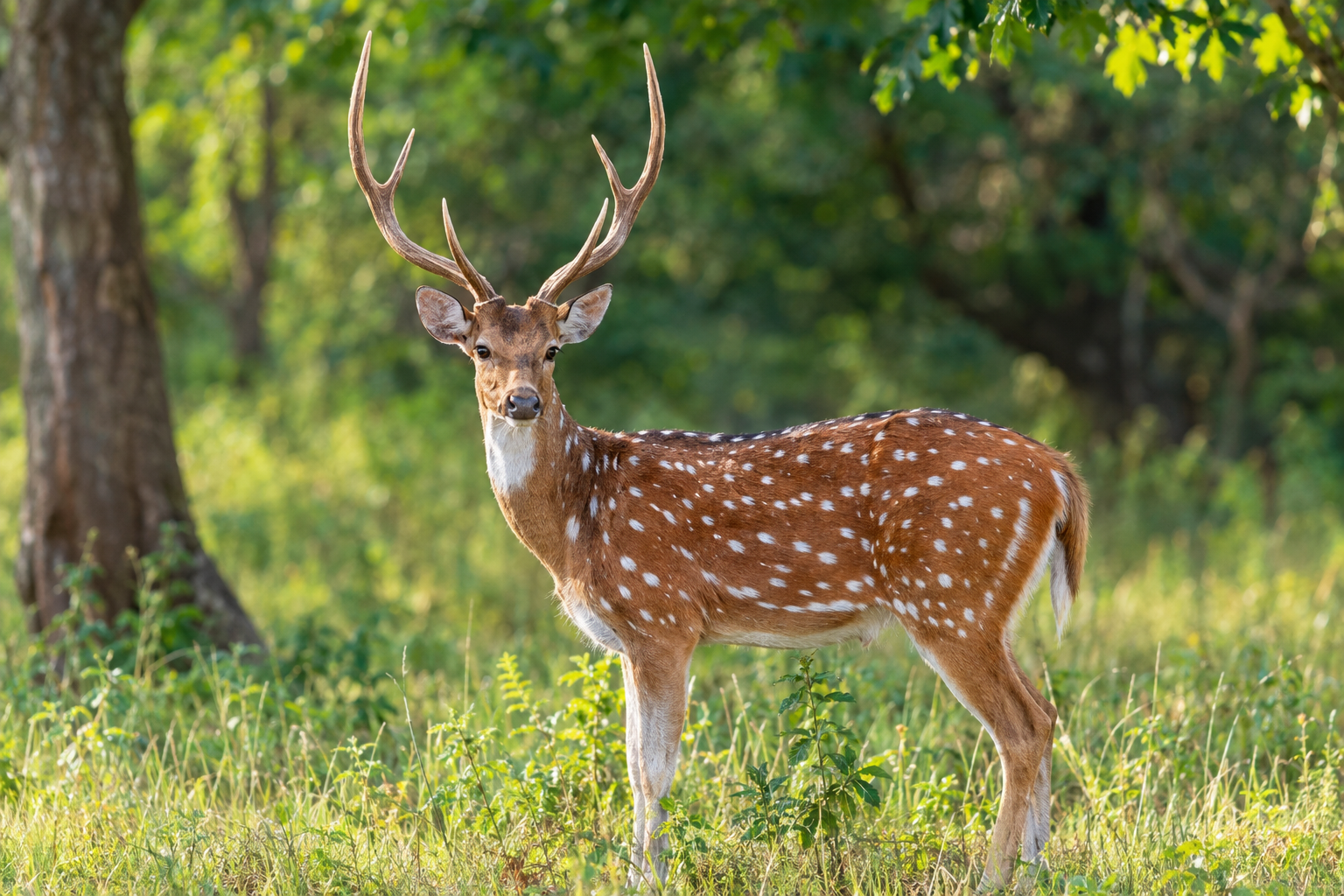
The axis deer is one of the most recognizable deer species in the world, famous for its reddish-brown coat, beautiful white spots, and impressive antlers. Also known as the chital, this graceful mammal is native to the Indian subcontinent and has established introduced populations in places such as Texas and Hawaii. Its adaptability, social behavior, and distinctive appearance make it an interesting subject for wildlife enthusiasts, photographers, researchers, and nature lovers.
Learning about axis deer reveals much more than their attractive spotted coats. Their habitat, feeding habits, breeding patterns, herd structure, and ability to adapt to different environments all help explain their success in the wild. Although they may look similar to other deer, several characteristics make them easy to distinguish once you know what to look for.
In this complete guide, we explore axis deer facts, including where axis deer live, what they eat, how they behave, how long they live, and why their presence matters for local ecosystems.


1. What Is an Axis Deer?
An axis deer is a medium-sized member of the deer family, Cervidae. Its scientific name is commonly written as Axis axis, and its widely used alternative name, chital, comes from the Indian subcontinent, where the species naturally occurs.
Axis deer are herbivorous mammals that primarily feed on grasses but also consume leaves, fruits, shoots, and other plant material. They typically inhabit environments that combine open feeding areas with trees, shrubs, and access to water. These conditions allow them to find food while remaining close to shelter.
Unlike deer species whose coats become less spotted with age, axis deer generally retain their distinctive white spots throughout adulthood. Their striking appearance, combined with their tendency to form herds, makes them particularly noticeable in suitable habitats.

Scientific Classification of Axis Deer
| Classification | Details |
|---|---|
| Common name | Axis deer |
| Alternative name | Chital or spotted deer |
| Scientific name | Axis axis |
| Kingdom | Animalia |
| Class | Mammalia |
| Order | Artiodactyla |
| Family | Cervidae |
| Diet | Herbivorous |
| Native range | Indian subcontinent |
| Typical habitat | Grasslands, woodland edges, and open forests |
| Conservation status | Least Concern, according to the IUCN as reported in species references |
The name Axis axis is used in modern wildlife literature, although older sources may use Cervus axis. The species is classified as Least Concern globally, but its local status and ecological effects vary by location.
Why Are Axis Deer Special?
Axis deer stand out because of their permanent white spots, long legs, alert posture, and impressive male antlers. They also have flexible feeding habits and can thrive where food, water, and shelter are available.
Their success in some introduced environments demonstrates how an animal that is well adapted to its native ecosystem can become established elsewhere. However, this adaptability can create management challenges where axis deer compete with native wildlife or put pressure on vegetation.
2. Axis Deer Appearance and Physical Characteristics
The appearance of axis deer is one of the main reasons people search for information about this species. Their colorful coats and distinctive markings make them relatively easy to identify, especially when compared with deer that have plain brown fur.
Coat Color and White Spots
An adult axis deer usually has a reddish-brown, chestnut, or golden-brown coat covered with rows of white spots. The spots extend across much of its back and sides and generally remain visible throughout its life.
The belly, throat, inner legs, and area beneath the tail are lighter in color. A dark stripe running along the spine adds another identifying feature. Male axis deer may become darker in appearance as they mature.
The spotted coat is particularly noticeable in sunlight, when the contrast between the white markings and brown fur becomes clearer.
Size and Weight
Axis deer are medium-sized ungulates, although body measurements vary with sex, age, nutrition, and location. Males are generally larger and heavier than females.
| Physical characteristic | Typical description |
|---|---|
| Body color | Reddish-brown to golden-brown |
| Markings | White spots across the body |
| Belly | Pale or white |
| Legs | Long and slender |
| Tail | Short, with a pale underside |
| Male antlers | Usually three points, or tines, on each side |
| Female antlers | Normally absent |
| Body size | Medium-sized deer, with males generally larger |
Male body weight can vary considerably, and figures from different populations should be treated as approximate rather than universal. Texas Tech’s mammal species account provides additional measurements and identifying characteristics.
Axis Deer Antlers
Male axis deer grow antlers that are generally made up of three prominent points on each side. These structures grow from the skull and play an important role in competition between males during the breeding season.
Antlers are not permanent horns. They grow, harden, and are eventually shed as part of a recurring biological cycle. Growth depends on age, nutrition, hormones, and general health.
Mature males may use their antlers when competing for access to females. These contests can involve displays, posturing, pushing, and direct clashes. The size and condition of antlers can therefore provide useful information about a male’s maturity, although antlers alone do not tell the whole story.
How to Identify an Axis Deer
Look for the following combination of characteristics:
- A reddish-brown body with white spots.
- A pale underside and white markings around the rump.
- A dark stripe along the back.
- Long, slender legs and an alert stance.
- Three-pointed antlers on typical mature males.
Seeing several of these features together is more reliable than identifying a deer by coat color alone.
3. Axis Deer Habitat: Where Do Axis Deer Live?
The natural habitat of axis deer includes grasslands, open woodland, forest edges, and areas near rivers or other reliable water sources. These environments provide a balance of food, shade, and protection from predators.
Axis deer are native to the Indian subcontinent, particularly India and neighboring parts of the region. Their distribution is associated with habitats where grasses and other edible plants are available alongside woody vegetation that provides cover.
Native Range of Axis Deer
In their native range, axis deer can be found in suitable grassland and woodland habitats. They often use open areas for grazing and move into wooded areas for shade, resting, and protection.
Their habitat requirements are not limited to a single vegetation type. The availability of food, seasonal rainfall, water, and cover can all influence where they spend their time.

What Makes a Good Axis Deer Habitat?
Several environmental features are particularly important:
- Grassland: Provides much of their regular food supply.
- Trees and shrubs: Offer shade, cover, and additional browse.
- Water sources: Help them meet daily water needs, especially in hot weather.
- Open spaces: Allow them to graze and remain alert to potential danger.
- Sheltered areas: Provide resting places and protection for young deer.
Axis deer frequently use the boundary between open grassland and woodland because it gives them access to both feeding areas and shelter. Research on the species in Nepal also describes the importance of combining open habitat with forested areas.
Axis Deer Habitat in Texas
Axis deer are not native to the United States. They were introduced into Texas during the 1930s and subsequently became established in parts of the state.
Today, free-ranging populations occur in areas including the Edwards Plateau and northern South Texas Plains. The combination of open grassland, woody vegetation, and water in parts of Texas provides conditions that suit the species.
However, being well adapted to an area does not mean an introduced animal is ecologically harmless. Where populations grow substantially, managers may need to consider competition for forage, impacts on vegetation, and interactions with native deer.
Do Axis Deer Live in Forests?
Yes. Axis deer use forest edges, open woodlands, and some forested environments, but they are not restricted to dense forests. Open spaces are important because they provide grasses and other forage.
They may also enter wooded areas to rest, escape heat, or find fallen fruit and leaves. Their habitat use changes according to food availability, weather, and the presence of disturbance or predators.
4. Axis Deer Diet: What Do Axis Deer Eat?
Axis deer are herbivores, and their diet is one of the key reasons for their success across different environments. Although grasses are an important food source, these deer can consume a broad range of plant material.
The exact axis deer diet depends on the season, local vegetation, rainfall, and availability of preferred foods. This flexibility helps them continue feeding when certain plants become less abundant.

Main Foods in the Axis Deer Diet
| Food type | How it contributes |
|---|---|
| Grasses | Provide a major part of the diet |
| Leaves | Supply additional plant nutrients |
| Young shoots | Offer tender, accessible forage |
| Flowers | Add variety when available |
| Fallen fruit | Provides seasonal food and energy |
| Seeds and other plant material | Supplement the diet |
| Woody browse | Becomes useful when grass availability changes |
| Sedges and other herbaceous plants | Provide additional forage in suitable habitats |
Studies and species accounts describe axis deer as primarily grazers that also browse on leaves, shoots, and other vegetation. The proportion of each food type can change depending on environmental conditions.
Do Axis Deer Eat Grass?
Yes. Grass is one of the most important components of the axis deer diet. They commonly feed on available grasses and may prefer fresh, tender growth when it is abundant.
Young grasses can be easier to consume than mature, fibrous vegetation. In Texas, documented forage includes species such as paspalum, switchgrass, and little bluestem.
The availability of fresh grass changes throughout the year, so axis deer supplement grazing with other plants.
Do Axis Deer Eat Fruit and Leaves?
Yes. Axis deer may eat fallen fruits, flowers, leaves, and young shoots. These foods help diversify their diet and can provide valuable nutrients when grasses are less available.
In wooded habitats, fallen fruit and leaves can be especially useful sources of food. Axis deer also browse on shrubs and trees when conditions make this necessary.
How Does the Season Affect Their Diet?
Food availability changes with rainfall, temperature, and plant growth.
- Wet seasons: Fresh grass and other green vegetation may become more abundant.
- Dry seasons: Deer may rely more heavily on available browse and other plants.
- Seasonal transitions: A mixture of grasses, leaves, and fruit can help maintain a varied diet.
The ability to switch between food sources is a useful adaptation, but it does not eliminate the effects of drought or habitat degradation. When too many deer depend on a limited area, competition for food can become more intense.
How Do Axis Deer Digest Their Food?
Like other ruminants, axis deer have a specialized digestive system that allows them to process fibrous plant material. They initially swallow food, later bring it back up as cud, and chew it again before completing digestion.
This process helps them extract nutrients from vegetation that many other mammals cannot use as efficiently. Their digestive adaptation is an important part of their survival as grazing animals.
5. Axis Deer Behavior and Social Structure
Axis deer are social animals that commonly live in groups. Their behavior includes grazing together, watching for danger, communicating through sounds, and adjusting their group structure according to age, sex, and breeding activity.
Herd size varies. Some groups contain only a few individuals, while others can become much larger where food, water, and suitable habitat support them.
How Do Axis Deer Form Herds?
Axis deer groups often include adult females and their young. Older females can play an important role in group movement and behavior.
Males may form groups of their own at some times of the year, while breeding activity can bring males into closer association with female herds.
Common group types include:
- Family groups: Females and their offspring.
- Nursery groups: Females with young fawns.
- Male groups: Males spending time together outside intense breeding competition.
- Mixed groups: Herds that include different ages and sexes.
These groupings are flexible rather than permanent. Individual deer may move between groups as they mature or as breeding and feeding conditions change.
Are Axis Deer Active During the Day?
Axis deer can be active during daylight, particularly in habitats where disturbance is limited. Their activity patterns also depend on weather, feeding opportunities, and the risk of encountering predators or people.
They may feed during cooler parts of the day and rest in shaded areas during hot periods. In some locations, their activity can shift toward nighttime when human disturbance is high.
It is therefore inaccurate to assume that every axis deer population follows exactly the same daily schedule.
How Do Axis Deer Communicate?
Axis deer communicate through vocalizations, body language, posture, and scent-related signals.
Their sounds can include alarm barks, calls associated with breeding, and vocalizations made by young deer. These sounds can help individuals respond to danger or maintain contact with other herd members.
Body posture also communicates important information. A deer that suddenly becomes rigid, raises its head, or stares toward an unfamiliar sound may have detected something potentially dangerous.
Do Axis Deer Fight?
Yes. Male axis deer can compete with one another, especially during the breeding season. They may display their size, posture, and antlers before a contest becomes physical.
Conflicts can include pushing, chasing, and antler contact. Competition may help establish which males gain access to receptive females.
Axis deer are often described as relatively calm under ordinary conditions, but they are wild animals. Their behavior can become unpredictable when they are stressed, crowded, cornered, or competing.
Wildlife safety tip: Never approach an axis deer to touch, feed, or photograph it at close range. Give the animal room to move away, particularly if it has antlers or is protecting a young fawn.
6. Axis Deer Lifespan and Life Cycle
The axis deer lifespan depends on several factors, including food availability, habitat quality, disease, predation, accidents, and human activity. Deer living under managed care may survive longer than many free-ranging animals because they can receive veterinary treatment and have more consistent access to food.
Texas Tech’s species account gives a typical lifespan of approximately 9–13 years in the wild, while some animals in human care live considerably longer. These figures are estimates, not guarantees for every individual.
The Main Stages of an Axis Deer’s Life

1. Fawn stage
A young axis deer is called a fawn. During its earliest weeks, it depends heavily on its mother for milk, protection, and care. Its spotted coat helps it blend into the surrounding vegetation.
2. Juvenile stage
As the fawn grows, it begins eating more vegetation and gradually becomes more independent. It learns to recognize danger, move with other deer, and locate suitable feeding areas.
3. Young adult stage
Young deer develop greater strength and coordination. Females can reach reproductive maturity relatively early, while males may need additional time to become physically competitive with mature adults.
4. Mature adult stage
Adult deer spend much of their time feeding, resting, socializing, and responding to changes in their environment. Mature males may devote additional energy to antler growth and breeding competition.
5. Old age
Older deer may become less physically competitive and more vulnerable to injuries, illness, or limited food supplies. Their survival depends on the conditions of their habitat and the pressures they encounter.
What Affects Axis Deer Lifespan?
Important factors include:
- Access to adequate food and clean water.
- Suitable shelter and resting areas.
- Disease and parasites.
- Predators and other natural threats.
- Severe weather and drought.
- Collisions, hunting, and other human-related risks.
Good habitat can improve an animal’s chances of survival, but even a healthy deer can face risks that are beyond its control.
7. Axis Deer Reproduction and Breeding Season
Axis deer reproduction is notable because breeding can occur during much of the year in some populations. Unlike species with a sharply defined mating season, axis deer may show extended reproductive activity, depending on climate and local conditions.
In Texas, breeding commonly peaks during the warmer months, especially around June and July. Timing can differ across the species’ range and between managed and free-ranging populations.

How Do Axis Deer Mate?
During the breeding period, males may follow female groups and compete with other males for mating opportunities. Displays, vocalizations, scent cues, and antler contests can all contribute to reproductive behavior.
A male’s age, body condition, and ability to compete may affect his chances of mating. Females select mates within the context of their environment and the available males, rather than all males having equal reproductive success.
How Long Is the Axis Deer Pregnancy?
The gestation period is approximately seven to eight months, with estimates varying among sources and populations. Females usually give birth to a single fawn, although twins can occur.
After birth, the mother nurses and protects the young deer. Fawns gradually begin eating vegetation while continuing to depend on their mothers during early development.
When Are Axis Deer Fawns Born?
Birth timing depends on when breeding takes place. In parts of Texas, many births occur during the cooler months following the main summer breeding peak. In other regions, births may occur at different times because the species’ reproductive cycle is influenced by local conditions.
A female that gives birth must balance nursing, feeding, and avoiding danger. Suitable vegetation and secluded resting places are particularly important for young fawns.
8. Axis Deer Predators and Natural Threats
Axis deer face different predators depending on where they live. In their native range, large carnivores can pose a significant threat. In introduced areas, the predator community is different, and the relative importance of predation can change.
Natural Predators in the Native Range
In parts of India, axis deer may be preyed upon by tigers, leopards, and other carnivores. Young fawns can be especially vulnerable because they are smaller and less capable of escaping danger.
Their survival depends partly on vigilance, the availability of cover, and the ability to respond quickly when a predator approaches.
Predators in Texas
In Texas, documented potential predators include coyotes and bobcats. However, predation pressure differs from that in the species’ native range, and it may not be sufficient to control axis deer populations in all areas.
Human activities, habitat conditions, and food availability also influence survival and population growth.
How Do Axis Deer Protect Themselves?
Axis deer rely on several strategies to reduce risk:
- Remaining alert to sounds and movement.
- Using their hearing and sense of smell to detect danger.
- Moving quickly when threatened.
- Staying in groups, which can help individuals detect potential threats.
- Using vegetation and wooded areas for cover.
- Giving alarm calls when they detect something unusual.
These behaviors do not make axis deer immune to predators. They simply improve their chances of recognizing and escaping danger.
Are Axis Deer Dangerous to Humans?
Axis deer generally avoid people when they have a clear escape route. However, they remain wild animals and can injure someone if they feel threatened.
Adult males with hard antlers deserve particular caution during the breeding season. Feeding deer by hand or approaching them for close-up photographs can encourage unsafe interactions.
The safest approach is to observe axis deer from a respectful distance and never block their path.
9. Axis Deer vs. White-Tailed Deer
Axis deer and white-tailed deer are both members of the deer family, but they differ in appearance, feeding habits, and geographic origins. The comparison is especially relevant in Texas, where the two species can occupy overlapping habitats.


Comparison Table
| Feature | Axis deer | White-tailed deer |
|---|---|---|
| Scientific name | Axis axis | Odocoileus virginianus |
| Native range | Indian subcontinent | Americas |
| Coat pattern | White spots generally persist into adulthood | Adults usually have a more uniform coat |
| Body color | Often reddish or golden brown | Usually brown, with seasonal variation |
| Antlers | Typically three tines per side | Antler shape and branching vary |
| Diet | Primarily grasses, plus browse and other plants | Browse, forbs, fruits, and other foods; grass use varies |
| Social behavior | Frequently forms mixed herds | Social grouping varies by season and sex |
| Introduced status in Texas | Non-native | Native |
| Ecological concern | Can compete with native wildlife where abundant | Part of the native ecosystem |
Which Deer Is Larger?
Body size varies across both species, so it is not always possible to identify an animal by size alone. Mature male axis deer can be substantial animals, while white-tailed deer size varies geographically.
Coat pattern, body shape, antlers, and tail characteristics are more useful when considered together.
Do Axis Deer Compete With White-Tailed Deer?
They can. In areas where both species share resources, axis deer may compete with white-tailed deer for food and suitable habitat. Their ability to graze extensively can give them an advantage under certain environmental conditions, especially when resources are limited.
The extent of competition depends on population density, habitat, drought, forage availability, and other factors. It should not be assumed that every area containing both species experiences the same level of impact.
10. Axis Deer in Texas and Other Introduced Regions
Axis deer have become well established in certain regions outside their native range. Texas is one of the most notable examples, where introduced populations have expanded beyond their original managed settings.
Why Were Axis Deer Introduced to Texas?
Axis deer were introduced into Texas around 1932. Early introductions were associated with game ranches and the development of opportunities for hunting exotic wildlife. Over time, some animals established free-ranging populations.
Today, axis deer are particularly associated with the Edwards Plateau and parts of the northern South Texas Plains. These regions contain areas of grassland, brush, and woodland that can provide suitable habitat.

Axis Deer in Hawaii
Axis deer have also been introduced to Hawaii, where they have established populations on certain islands. Their presence creates different management challenges from those in their native range.
In suitable environments, deer may feed on vegetation, use agricultural land, and reproduce when conditions are favorable. Where populations become excessive, browsing pressure can damage vegetation and affect habitat used by other species.
The specific effects vary by island and ecosystem, so local wildlife agencies are important sources for current population and management information.
Why Can Introduced Axis Deer Become a Concern?
An introduced species can thrive in a new location if it encounters favorable habitat, sufficient food, and relatively few effective natural controls. Axis deer are adaptable feeders and can reproduce successfully under suitable conditions.
Possible concerns include:
- Competition with native herbivores.
- Damage to crops, gardens, and young trees.
- Excessive grazing and browsing.
- Pressure on vegetation near water sources.
- Road collisions and other human-wildlife conflicts.
These concerns are not identical in every region. Responsible management depends on local evidence, population monitoring, and the needs of native ecosystems.
11. Ecological Impact and Conservation
Axis deer are classified as Least Concern globally, but their ecological role differs between native and introduced environments. In their native range, they form part of the natural food web. In regions where they have been introduced, high densities can create management challenges.
Are Axis Deer an Invasive Species?
The answer depends on the location and the ecological context.
In their native range, axis deer are a natural component of the ecosystem. In areas where people introduced them, they are non-native. They may be considered invasive or problematic where their spread or abundance causes significant ecological harm.
Being non-native does not automatically mean that a species causes severe damage everywhere. Local evidence is needed to determine its impact.
How Can Large Populations Affect Vegetation?
When too many deer feed in a limited area, they can consume vegetation faster than it grows back. This can reduce the availability of young plants, affect tree regeneration, and change the structure of plant communities.
Areas around water sources and frequently used feeding sites may experience concentrated pressure. Under drought conditions, competition can become more intense because plants grow more slowly and fewer feeding options remain.
How Are Axis Deer Populations Managed?
Depending on the region, management can include:
- Monitoring population size and distribution.
- Assessing vegetation and habitat conditions.
- Evaluating competition with native species.
- Managing populations according to local wildlife laws.
- Protecting sensitive habitats.
- Educating landowners and the public about responsible wildlife practices.
Management approaches should reflect the local situation. Regulations governing hunting, possession, transport, or control of axis deer differ between jurisdictions, so official wildlife guidance should always be checked before taking action.
12. 15 Interesting Axis Deer Facts

Here are 15 interesting facts about axis deer that help explain what makes these animals distinctive.
1. They are also called chital. The name chital is widely used for axis deer in their native range.
2. Their scientific name is Axis axis. This is the name commonly used in modern species references.
3. They have permanent-looking white spots. Unlike many other spotted deer, axis deer generally retain their spots as adults.
4. They are native to the Indian subcontinent. Their natural range includes India and nearby parts of the region.
5. Males grow distinctive antlers. Mature males typically have three prominent tines on each side.
6. Females are usually smaller. Adult females generally have a lighter build and lack antlers.
7. Grass is a major food source. Their diet also includes leaves, fruits, flowers, and woody browse.
8. They are social animals. Axis deer frequently form groups, although herd composition changes over time.
9. They use a variety of calls. Alarm barks and breeding-related vocalizations help them communicate.
10. They need access to suitable water sources. Water availability is especially important in hot environments.
11. They use both open and wooded habitats. Grasslands provide food, while trees and shrubs offer shade and cover.
12. They have been introduced to Texas. Introductions began around 1932, and free-ranging populations subsequently became established.
13. They can compete with native deer. Competition may occur where the species share food and habitat, particularly when resources are scarce.
14. Their breeding activity can extend across the year. The timing and intensity of reproduction vary by location, with a more noticeable peak in some populations.
15. Their ecological impact depends on location. Axis deer are a natural species in their native range but may require management in areas where they are introduced and become abundant.
These characteristics show why axis deer are important both as a wildlife species and as an example of how introduced animals can influence new environments.
13. Frequently Asked Questions About Axis Deer
What is an axis deer?
An axis deer is a medium-sized deer species native to the Indian subcontinent. It is also known as the chital and is recognized by its reddish-brown coat, rows of white spots, and the antlers of adult males.
Where do axis deer live?
Axis deer naturally live in suitable habitats across parts of the Indian subcontinent. They use grasslands, open woodland, and forest edges. Introduced populations also exist in places such as Texas and Hawaii.
What do axis deer eat?
Axis deer primarily eat grasses but also consume leaves, young shoots, flowers, fruits, and woody browse. Their diet changes according to the season and the plants available in their habitat.
How long do axis deer live?
Wild axis deer commonly live around 9–13 years according to the Texas Tech species account, although lifespan varies. Some animals in human care can live longer.
Why do axis deer have white spots?
The white spots are a natural feature of their coat. They form a distinctive pattern that remains visible through adulthood. Their precise evolutionary role should not be reduced to a single explanation without further evidence.
Are axis deer endangered?
Axis deer are classified as Least Concern globally. However, local populations may face different threats, and introduced populations can create ecological problems in some regions.
Are axis deer native to the United States?
No. Axis deer are native to the Indian subcontinent. They were introduced to Texas during the 1930s and have also been introduced to Hawaii.
What is the difference between axis deer and white-tailed deer?
Axis deer have rows of white spots that generally persist into adulthood and usually have three-pointed antlers on each side. White-tailed deer typically have a more uniform adult coat and variable antler branching. The two species also have different native ranges.
Do axis deer live in herds?
Yes. Axis deer often live in groups containing females and young. Males may form separate groups outside the breeding season, and herd composition changes with age, sex, and reproductive activity.
Are axis deer dangerous?
Axis deer usually avoid people when they can escape. However, they are wild animals and may injure people if threatened or approached too closely. Males with antlers can be particularly dangerous during breeding competition.
Why are axis deer common in Texas?
Axis deer were introduced to Texas, initially in association with game ranches. Suitable habitat, available food, and successful reproduction have helped establish free-ranging populations in parts of the state.
Do axis deer shed their antlers?
Yes. Like other deer with antlers, male axis deer go through a recurring antler growth and shedding cycle. Antlers are different from permanent horns.
How can you identify an axis deer?
Look for a reddish-brown body, white spots across the back and sides, a dark stripe along the spine, a pale underside, and, in mature males, antlers that typically have three points on each side.
Can axis deer survive in cold climates?
Axis deer generally favor milder conditions and can be vulnerable to severe winters. Their ability to survive depends on the severity and duration of cold weather, access to food, and available shelter.
What is the scientific name of the axis deer?
The commonly accepted scientific name is Axis axis. The species is also widely known as the chital or spotted deer.
14. Final Thoughts
The axis deer is a fascinating species known for its spotted coat, distinctive antlers, social behavior, and flexible feeding habits. Understanding its habitat, diet, lifespan, and reproduction provides a clearer picture of how it survives in the wild.
Although native to the Indian subcontinent, axis deer have also become established in introduced regions such as Texas and Hawaii. Their presence highlights an important wildlife lesson: a species can be admired for its beauty while still requiring careful management where it affects native ecosystems.
Whether you are researching axis deer facts for educational purposes, learning how to identify this spotted deer, or exploring its role in wildlife conservation, the most important details are its natural history, adaptability, and relationship with the environment.
