
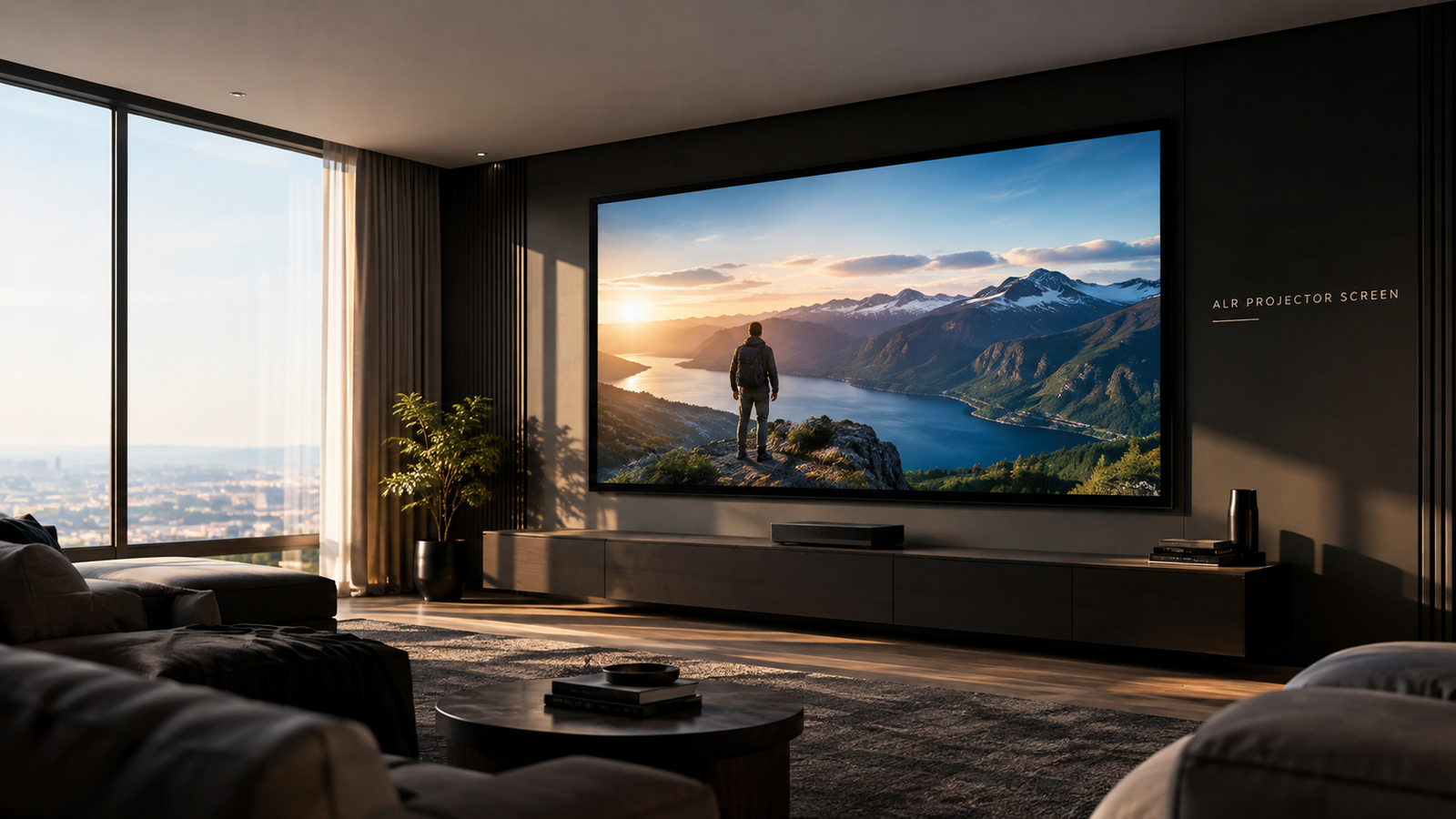
Watching movies on a projector can create a much larger and more cinematic picture than a traditional television, but ambient light can quickly reduce image quality. This is where an ALR projector screen can make a noticeable difference. ALR stands for Ambient Light Rejection, a screen technology designed to reject unwanted light from certain directions while directing more of the projector’s light toward the viewer.
Unlike a standard white projector screen, an ALR screen is engineered around how light behaves in a room. This makes it particularly useful for living rooms, conference spaces, classrooms, and other environments where completely dark conditions are difficult to achieve. However, ALR screens are not automatically the best choice for every projector or room.
What Is an ALR Projector Screen?
An ALR projector screen is a specially designed projection surface that reduces the visible effect of ambient light. Its optical surface is structured to reflect light from the projector toward the audience while limiting light coming from other directions.
The main purpose is not to make the projector brighter. Instead, the screen helps preserve perceived contrast and picture clarity when lamps, windows, ceiling lights, or other sources are present. This can make projected images look more watchable during the day compared with a conventional matte-white screen.
ALR technology is especially useful when a projector is being used in a room that cannot be completely darkened. For example, a home theater with blackout curtains may not need an ALR surface, while a bright family room could benefit considerably from one.
How Does an ALR Projector Screen Work?
The surface of an ALR screen uses optical properties that control how light is reflected. Instead of scattering projector light evenly in every direction, many ALR materials are designed to favor the viewer’s position.
At the same time, ambient light arriving from particular directions is reflected away from the viewing area or absorbed more effectively. The result can be a stronger-looking image with better perceived contrast in a room containing unwanted light.
The exact performance depends heavily on the screen’s optical design. Some ALR materials are optimized for traditional long-throw projectors, while others are designed specifically for ultra-short-throw (UST) projectors. These types should not be treated as interchangeable.
What Are the Benefits of an ALR Projector Screen?
The biggest advantage of an ALR projector screen is its ability to maintain a more convincing image when ambient light is present. This can be valuable for people who want a large projection setup without turning their room into a completely dark theater.
Better Image Visibility in Bright Rooms
Ambient light can wash out a projected image, making dark scenes look gray and reducing overall contrast. An appropriate ALR screen can reduce this effect and help the picture retain more visual depth.
This is one reason ALR screens are popular in living rooms and multipurpose spaces. You can use the projector without depending entirely on blackout curtains or switching off every light.
Improved Perceived Contrast
Projector contrast is often one of the first things affected by unwanted light. When the screen is illuminated by both the projector and surrounding light sources, blacks can appear less convincing.
By controlling how external light reaches the viewing area, an ALR screen can help preserve perceived contrast. The improvement is most noticeable when the room has meaningful ambient light.
More Flexible Viewing Conditions
A conventional projection setup often works best in a dark room. An ALR screen gives you more flexibility, especially if the room has windows or needs to remain partially illuminated.
This makes the technology useful beyond dedicated home theaters. It can also work well for presentations, entertainment rooms, and spaces where controlling every light source is impractical.
What Are the Disadvantages of ALR Screens?
Despite their benefits, ALR projector screens have some disadvantages. The technology involves trade-offs, and the best screen depends on the projector, room, viewing position, and screen material.
Higher Cost
One of the biggest drawbacks is price. ALR screens generally cost more than basic matte-white projection screens because their optical surfaces require more specialized materials and manufacturing.
If you already have a dark room, spending extra money on ALR technology may provide relatively little practical benefit.
Viewing Angle Can Be More Limited
Some ALR screens have a narrower optimal viewing angle than traditional screens. The image may look best when viewers sit within the screen’s intended viewing area.
This matters in larger rooms where people regularly watch from the sides. Before buying one, it is important to check the manufacturer’s recommended viewing angle rather than assuming every seat will look identical.
Potential Hotspotting or Uneven Brightness
Certain optical screen materials can produce hotspotting, where part of the screen appears noticeably brighter than another area when viewed from certain positions.
The severity varies by screen technology and projector setup. A high-quality ALR material can minimize these issues, but they should still be considered when comparing screens.
Not Every Projector Is Compatible
ALR screens are not universally compatible with every projection setup. Screen material, projector throw distance, lens position, brightness, and installation angle can all influence performance.
UST projectors in particular require screens designed specifically for ultra-short-throw projection. Using the wrong material can lead to poor uniformity, unwanted reflections, or a disappointing image.
How Much Does an ALR Screen Cost?
The cost of an ALR screen varies considerably depending on its size, material, optical technology, frame design, and intended projector type.
A basic fixed-frame ALR screen may be relatively affordable, while premium motorized or acoustically transparent models can cost significantly more. UST-compatible ALR screens can also command a higher price because they require a specialized surface structure.
As a general buying principle, don’t choose an ALR screen solely because it has a higher price or gain specification. The important question is whether its optical characteristics match your projector and room.
For a home setup, the total budget should also account for the projector, mounting hardware, installation, room lighting, and viewing distance. A cheaper screen that works well with the projector can often produce a better overall setup than an expensive screen that is poorly matched to the equipment.
Is an ALR Projector Screen Worth It?
An ALR projector screen is worth it when ambient light is a genuine problem and you want to use a projector without completely darkening the room.
For example, if sunlight enters through windows during the day or you regularly keep some lights on while watching movies, an ALR screen can make the projected image easier to see. The improvement can be particularly noticeable with darker scenes and content that depends on contrast.
However, an ALR screen may not be necessary for a dedicated home theater with excellent light control. In a dark room, a quality conventional screen can already provide excellent results, and the additional cost of ALR technology may not deliver enough improvement to justify the upgrade.
The best choice therefore depends less on the label “ALR” and more on your specific viewing environment.
ALR vs. Standard Projector Screen
The difference between an ALR screen and a conventional screen mainly comes down to how each surface handles light.
| Feature | ALR Projector Screen | Standard Projector Screen |
|---|---|---|
| Ambient light handling | Better in suitable conditions | More affected by room light |
| Price | Usually higher | Usually lower |
| Viewing angle | Can be narrower | Often wider |
| Dark-room performance | Very good | Very good |
| Bright-room performance | Generally better | Can look washed out |
| Installation requirements | More specific | Usually simpler |
| Best for | Rooms with ambient light | Controlled or darker rooms |
This comparison does not mean an ALR screen will always outperform a standard screen. Screen material and projector compatibility are crucial, and different ALR technologies behave differently.
What Should You Consider Before Buying an ALR Screen?
Before purchasing an ALR projector screen, start by looking at the room rather than the screen itself. Identify where natural and artificial light enters the room and whether those sources can be controlled.
Next, check your projector’s specifications. Brightness, throw distance, lens placement, and projection technology can influence which screen material will perform properly.
Screen size is another important consideration. A larger screen is not automatically better if the projector does not produce enough light for the chosen size. Similarly, choosing an extremely high-gain material simply to increase brightness can introduce unwanted viewing-angle or uniformity issues.
Finally, consider how you normally use the projector. Someone watching movies at night in a dark room has very different requirements from someone watching sports in a bright living room during the afternoon.
ALR Screens for UST Projectors
Ultra-short-throw projectors deserve special attention because they project light onto the screen from a very steep angle.
A regular ALR screen designed for a long-throw projector may not work correctly with a UST projector. UST screens use specialized optical structures that are designed to reflect the projector’s light toward viewers while rejecting light coming from above.
If you are buying a UST projector, look specifically for a screen labeled as UST-compatible ALR rather than simply choosing any screen described as ambient-light rejecting.
Final Verdict
An ALR projector screen can be an excellent investment when a projector needs to operate in a room with noticeable ambient light. Its optical surface can improve perceived contrast, preserve image visibility, and make daytime or partially lit viewing more practical.
However, ALR technology comes with compromises, including higher prices, potentially narrower viewing angles, and stricter compatibility requirements. It is therefore not automatically the best option for every home theater.
If your room can be made very dark, a good standard projection screen may be enough. If controlling ambient light is difficult, choosing the right ALR material for your projector can make a much bigger difference.
Frequently Asked Questions
What is an ALR projector screen?
An ALR projector screen is a projection surface designed to reject ambient light from certain directions while directing projector light toward the viewer. It can help maintain image visibility and perceived contrast in rooms that are not completely dark.
What are the disadvantages of ALR screens?
Common disadvantages include a higher purchase price, potentially narrower viewing angles, possible hotspotting with some materials, and compatibility requirements. The screen must be properly matched to the projector and room.
How much does an ALR screen cost?
ALR screen prices vary depending on size, material, projector compatibility, construction, and whether the screen is fixed-frame or motorized. Premium UST-compatible models can cost considerably more than basic projection screens.
Is an ALR projector screen worth it?
An ALR screen can be worth the investment if your room has significant ambient light. For a dedicated dark home theater, however, a conventional high-quality screen may offer better value without the additional ALR cost.
Can I use an ALR screen with any projector?
Not necessarily. Different ALR materials are designed for different projection angles and projector types. UST projectors generally require specially designed UST-compatible ALR screens for proper image performance.
